Tag: lanthanated tungsten

  • TIG Tungsten Balling Causes on AC Welding: Aluminum Setup, AC Balance, Amperage, and Electrode Choice

    TIG tungsten balls on AC because the electrode is getting too hot at the tip. A small controlled ball can be normal on older transformer-style AC aluminum welding, especially with pure or zirconiated tungsten. Excessive balling, mushrooming, splitting, wandering arc, or tungsten dropping into the weld usually means the tungsten is overloaded, the AC balance puts too much heat on the electrode, the tungsten diameter is too small, the electrode type is wrong for the machine, or the shielding gas is not protecting the hot tungsten.

    On modern inverter AC TIG machines, a sharp or truncated point is usually preferred over a large ball. If the tungsten balls immediately reduce electrode-positive cleaning action, use a larger tungsten, switch to 2% lanthanated, ceriated, or zirconiated tungsten depending on the machine and procedure, shorten stickout, verify argon coverage, and confirm the torch is not overheating.

    Related TIG checks include why TIG tungsten turns black, TIG porosity troubleshooting, and TIG cup size and gas coverage selection.

    Common Symptoms

    SymptomLikely CauseFirst Check
    Tungsten forms a large ball immediatelyToo much heat on electrode, tungsten too small, wrong AC balanceCheck tungsten diameter and reduce cleaning action
    Ball grows wider than tungsten diameterElectrode overloadedUse larger tungsten or reduce amperage
    Arc wanders around the ballBall too large or contaminated tungstenRegrind to truncated point
    Tungsten splits or spits into puddleOverheating, contamination, wrong tungsten typeReplace electrode and verify AC settings
    Tungsten turns black after weldingPoor post-flow or gas coverage failureCheck argon flow, cup, gas lens, and post-flow

    What Causes Tungsten Balling on AC?

    • Too much electrode-positive time: More cleaning action puts more heat into the tungsten.
    • Tungsten diameter too small: A small electrode cannot carry the selected amperage without melting back.
    • Wrong tungsten for the machine: Pure tungsten balls easily and is mainly associated with older transformer AC machines.
    • Too much amperage: The electrode overheats before the puddle stabilizes.
    • Long tungsten stickout: Poor cooling and weak gas coverage let the tip overheat and oxidize.
    • Contamination: Touching filler, puddle, aluminum oxide, or dirty base metal makes the tip deform.
    • Poor shielding gas: Low flow, high turbulent flow, cracked cup, bad gas lens, or short post-flow damages the hot tungsten.

    Electrode Choice Notes

    For older transformer AC aluminum welding, pure tungsten may naturally form a balled end. Zirconiated tungsten is often used where a balled or rounded end is desired with better contamination resistance. On modern inverter AC machines, lanthanated and ceriated tungstens usually hold a prepared point better and give a more focused arc. Do not assume the same tungsten prep works for every AC TIG machine.

    Tungsten TypeAC BehaviorNotes
    Pure tungstenBalls readilyMostly for transformer AC; lower current capacity
    ZirconiatedRetains rounded/balled end betterGood AC choice where weld contamination is a concern
    LanthanatedHolds point well on inverter ACCommon modern AC/DC TIG choice
    CeriatedGood starts and stable arcOften used for lower-amperage TIG
    ThoriatedLess common for AC aluminum todayRadiation concern; verify shop procedure

    Inspection Steps

    1. Identify the machine type. Transformer AC and inverter AC do not use the same tungsten-prep approach.
    2. Check tungsten diameter. If the ball exceeds the electrode diameter or forms instantly, the electrode may be undersized for amperage.
    3. Check AC balance. Reduce cleaning action if the machine is putting excessive heat into the tungsten.
    4. Check AC frequency if available. Higher frequency focuses the arc but can require a stable prepared tip.
    5. Regrind the tungsten. Use a clean truncated point for inverter AC unless the procedure calls for a ball.
    6. Inspect gas coverage. Check cup size, cracked cup, gas lens condition, argon flow, and post-flow.
    7. Clean aluminum thoroughly. Remove oxide and contamination before welding; do not make the tungsten carry the cleaning burden.
    8. Watch torch heat. A hot air-cooled torch can contribute to consumable and tungsten failure.

    Field Fix vs Proper Fix

    ProblemField FixProper Fix
    Large ball forms instantlyLower amperage and reduce cleaning actionUse correct tungsten diameter and AC balance
    Arc wandersRegrind tungstenUse truncated point and correct AC frequency/balance
    Tungsten spits into weldStop and replace tungstenCorrect overheating, contamination, and tungsten type
    Black tungsten after weldIncrease post-flowRepair gas leaks and replace damaged cup/gas lens
    Repeated balling on aluminumMove to larger tungstenMatch electrode, amperage, machine type, and procedure

    Common Wrong-Part Mistakes

    • Using pure tungsten on an inverter machine when lanthanated or ceriated would hold shape better.
    • Using 1/16 in. tungsten for amperage that needs 3/32 in. or larger.
    • Buying cups, collets, or gas lenses without confirming torch series and tungsten diameter.
    • Trying to fix excessive balling by increasing gas flow until turbulence pulls in air.
    • Using a balled tip because it was common on old transformer machines, even though the inverter setup wants a truncated point.

    Compatibility Notes

    Tungsten choice depends on machine type, AC waveform control, amperage, tungsten diameter, base metal, and procedure. Torch consumables must match the torch family, cup style, collet size, and tungsten diameter. If using WP-17, WP-18, or WP-26 style parts, verify the actual torch body and gas lens setup before ordering.

    Related Failure Paths

    • Arc wandering from a large or contaminated tungsten ball.
    • Black tungsten from poor post-flow or gas leakage.
    • Aluminum porosity from poor cleaning or shielding.
    • Dirty weld starts from contaminated tungsten.
    • Gas lens/cup failure mistaken for tungsten failure.
    • Excess cleaning action overheating the electrode.

    Safety Notes

    • Let tungsten and torch parts cool before handling.
    • Use eye protection when grinding tungsten.
    • Use a dedicated tungsten grinder or wheel to avoid contamination.
    • Follow shop rules for thoriated tungsten handling and dust control.
    • Secure argon cylinders and use ventilation during test welds.

    Sources Checked

    • Miller guidance on AC TIG inverter tungsten selection.
    • CK Worldwide tungsten electrode characteristics guide.
    • CK Worldwide AC TIG aluminum setup notes.
    • Weld Support Parts TIG tungsten discoloration and gas coverage support pages.
    • Weld Support Parts TIG cup size and porosity troubleshooting pages.
  • How to Reduce TIG Tungsten Grinding Dust in a Small Shop

    How to Reduce TIG Tungsten Grinding Dust in a Small Shop

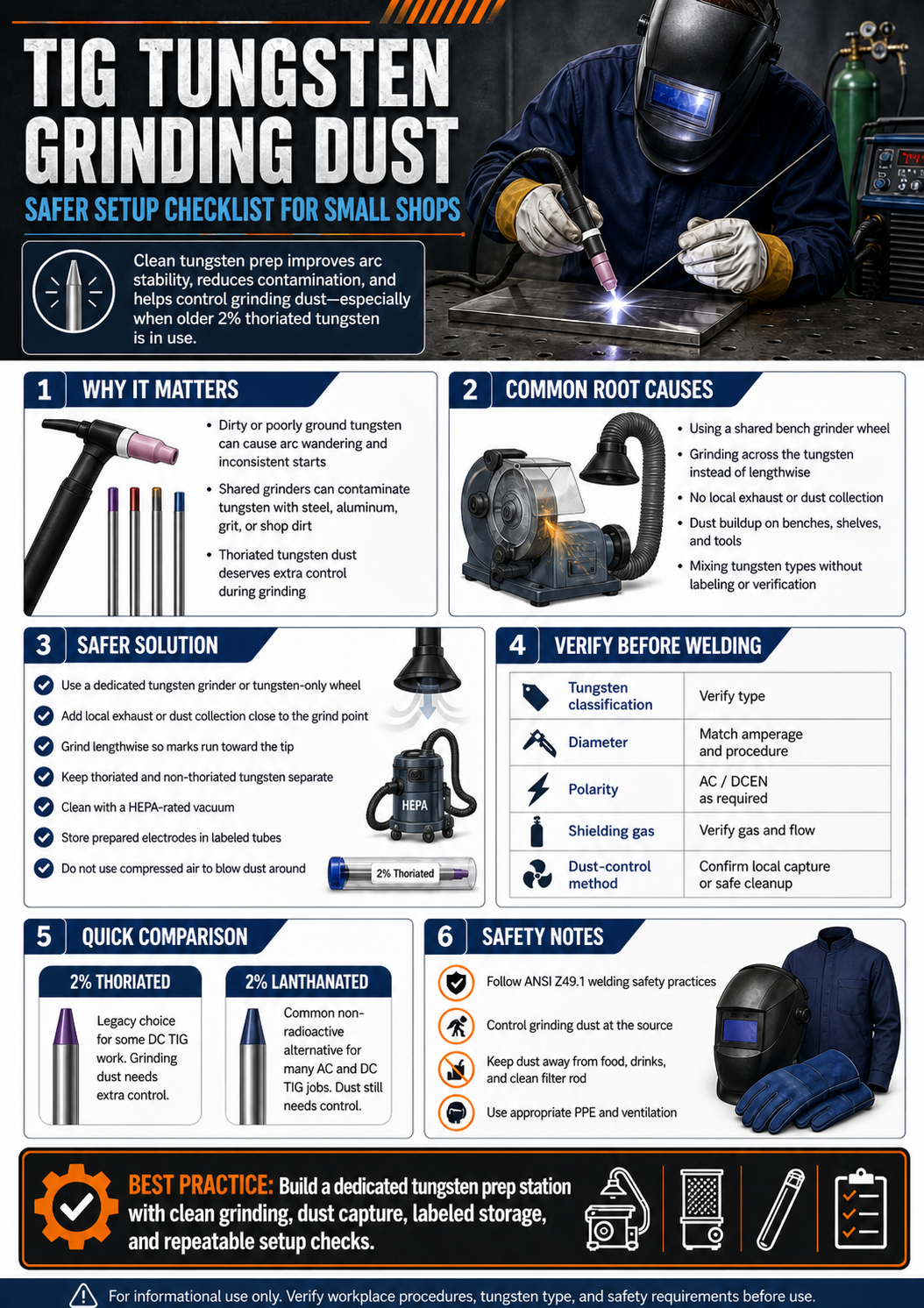
    TIG welding often depends on a clean, consistent tungsten point. The problem is that grinding tungsten electrodes can create fine dust, especially when older 2% thoriated tungsten is used. A simple shop setup can reduce exposure, improve point consistency, and keep tungsten prep from contaminating other grinding work.

    Key Takeaways

    • Dedicated tungsten grinding is cleaner than using a shared bench grinder wheel.
    • Thoriated tungsten grinding dust deserves extra control because thorium is radioactive.
    • Local exhaust, dust collection, and good housekeeping are more important than speed.
    • Lanthanated tungsten is a common non-radioactive alternative for many AC and DC TIG jobs.
    • Always verify tungsten type, diameter, current range, and job procedure before changing electrodes.

    Problem / Context

    A small TIG station may have a good machine, clean filler rod, and proper shielding gas, but still struggle with arc wandering, tungsten inclusions, and inconsistent starts. One overlooked cause is poor tungsten preparation. A shared grinder can load the tungsten with steel, aluminum, abrasive grit, or shop dirt. A poorly controlled grind can also send fine tungsten dust into the work area.

    This matters most when grinding thoriated tungsten. AWS safety guidance notes that thoriated tungsten contains thorium and that grinding dust can create an inhalation or ingestion concern. The safest approach is to control dust at the source and avoid casual dry grinding in open shop air.

    Root Causes

    • Using a shared grinder wheel that has already touched steel, stainless, or aluminum.
    • Grinding across the tungsten instead of lengthwise with the electrode axis.
    • Using thoriated tungsten without a dust-controlled sharpening process.
    • Letting grinding dust accumulate on benches, grinder guards, shelves, or nearby tools.
    • Switching tungsten types without checking procedure requirements and arc performance.
    • Using the wrong tungsten diameter for the amperage range. Unknown (Verify).

    Solution

    Set up a dedicated tungsten prep area instead of treating tungsten sharpening as a general grinding task. The setup should include a dedicated grinding surface, controlled dust capture, clear labeling for tungsten types, and a cleaning method that does not blow dust into the air.

    • Use a dedicated tungsten grinder, diamond wheel, or tungsten-only grinding attachment.
    • Position local exhaust or dust collection close to the grinding point.
    • Grind lengthwise so grind marks run toward the electrode tip.
    • Keep thoriated tungsten separate from lanthanated, ceriated, or other non-thoriated electrodes.
    • Clean with a HEPA-rated vacuum or other approved dust-control method. Do not use compressed air to scatter dust.
    • Store prepared tungstens in labeled tubes so clean points do not pick up bench contamination.

    Specs / Verification Notes

    Item to VerifyWhy It MattersStatus
    Tungsten classificationConfirms whether the electrode is thoriated, lanthanated, ceriated, pure tungsten, or another type.Unknown (Verify)
    Tungsten diameterDiameter must match the machine setting, torch capacity, and job procedure.Unknown (Verify)
    Welding polarityDCEN, AC, and special waveforms may require different tungsten choices and tip geometry.Unknown (Verify)
    Shielding gasGas type and flow affect arc behavior and tungsten life.Unknown (Verify)
    Dust-control methodOpen grinding is not the same as local capture or dust collection.Unknown (Verify)

    Product Section

    The following product was checked for a visible Amazon ASIN and cross-checked against manufacturer or welding-supply listings for the same Weldcraft part number. Verify diameter, package quantity, tungsten type, and seller listing before purchase.

    Miller Weldcraft WL2332X7 2% Lanthanated Tungsten Electrode 3/32 X 7″, 10 Pack
    • 2% Lanthanated (Blue) EWLa-2/WL20
    • Principal Oxide: 1.8 – 2.2% Lanthanum Oxide
    • Non-Radioactive. Best general purpose electrode for both Alternating Current (A/C) or Direct Current (D/C) using inverter or transformer based constant current power sources.
    • Good for low-alloyed steels, non corroding steels, aluminum alloys, magnesium alloys, titanium alloys, nickel alloys, copper alloys.
    • Good arc starts and stability, medium to high amperage range, low errosion rate.

    Last update on 2026-06-26 / Affiliate links / Images from Amazon Product Advertising API

    Comparison Table

    OptionUse CaseDust ConcernVerification Needed
    2% thoriated tungstenLegacy DC TIG procedures and qualified work where specifiedHigher concern when grinding because thorium is presentConfirm procedure requirement and dust controls
    2% lanthanated tungstenCommon non-radioactive option for many AC and DC TIG applicationsNo thorium dust, but grinding dust still needs controlConfirm machine, material, and procedure acceptance
    Pre-ground tungstenRepeat work where consistent tip geometry mattersReduces in-shop grindingConfirm point angle, flat, diameter, and tungsten type
    Dedicated tungsten grinderShops that sharpen oftenCan improve containment if paired with dust controlConfirm collector, wheel type, and electrode size range

    Safety Notes

    ANSI Z49.1 covers safety in welding, cutting, and allied processes, including protection of personnel, ventilation, fire prevention, and confined spaces. TIG welding still requires proper helmet shade, eye protection, gloves, clothing, ventilation, and protection from hot metal and ultraviolet radiation.

    AWS safety guidance for thoriated tungsten recommends dust-collecting grinders, local exhaust, and respiratory protection where needed to prevent inhalation of dust. Treat grinder dust as a controlled waste stream and follow workplace, local, and regulatory disposal rules.

    Do not use compressed air to clean tungsten grinding dust from a bench or grinder. Do not grind thoriated tungsten near food, drinks, open toolboxes, welding coupons, or clean filler rod. Do not assume a non-radioactive tungsten eliminates all respiratory risk; fine grinding dust should still be controlled.

    FAQ

    Is thoriated tungsten banned?

    Not universally. Some workplaces restrict or phase it out, while some qualified procedures still specify it. Verify the job requirement, employer policy, and local rules before use.

    Can lanthanated tungsten replace thoriated tungsten?

    Often, but not automatically. Lanthanated tungsten is widely used as a non-radioactive alternative, but procedure, machine type, base metal, amperage, and acceptance requirements must be verified.

    Should tungsten be sharpened on a belt sander?

    Only if the belt is dedicated to tungsten and dust is controlled. A shared belt can contaminate the tungsten and spread dust across the shop.

    Why does the arc wander after sharpening?

    Common causes include cross-grinding marks, an off-center point, contamination from a shared wheel, an oversized ball, incorrect tungsten diameter, or poor gas coverage.

    Is a tungsten grinder required?

    No, but a dedicated grinder or controlled sharpening setup can improve consistency and reduce contamination. The key requirement is a clean, repeatable grind with appropriate dust control.

    Next Step

    Build a small tungsten prep checklist at the TIG bench: tungsten type, diameter, point style, grinding direction, dust control, and storage tube. Keep the checklist with the torch consumables so every tungsten is prepared the same way before welding starts.

    Sources Checked

    • AWS Safety and Health Fact Sheet No. 27, Thoriated Tungsten Electrodes.
    • AWS Safety and Health Fact Sheet No. 2, Radiation.
    • ANSI Z49.1:2021, Safety in Welding, Cutting, and Allied Processes.
    • Miller Weldcraft product listing for Weldcraft 2% Lanthanated Tungsten WL2332X7.
    • Amazon product listing showing ASIN B00VMH8T6M for Miller Weldcraft WL2332X7.
    • Cyberweld listing for Weldcraft 2% Lanthanated Tungsten WL2332X7.
Listen with Audible