Category: Personal Protection Equipment

  • Welding Safety Glasses Guide 2025 | Shade Numbers, ANSI Z87.1 & UV Protection

    Welding Safety Glasses Guide 2025 | Shade Numbers, ANSI Z87.1 & UV Protection

    Welding safety glasses protect against UV radiation, infrared light, and impact hazards during grinding and fabrication. Choosing the right glasses depends on process type, shade number, and ANSI Z87.1 certification—not just lens color.

    ANSI Z87.1 Certification Requirements

    Impact Protection Levels

    Basic Impact (Z87) – Protects against low-velocity impact (1” steel ball at 150 ft/sec) – Suitable for: General shop work, light grinding, non-welding tasks

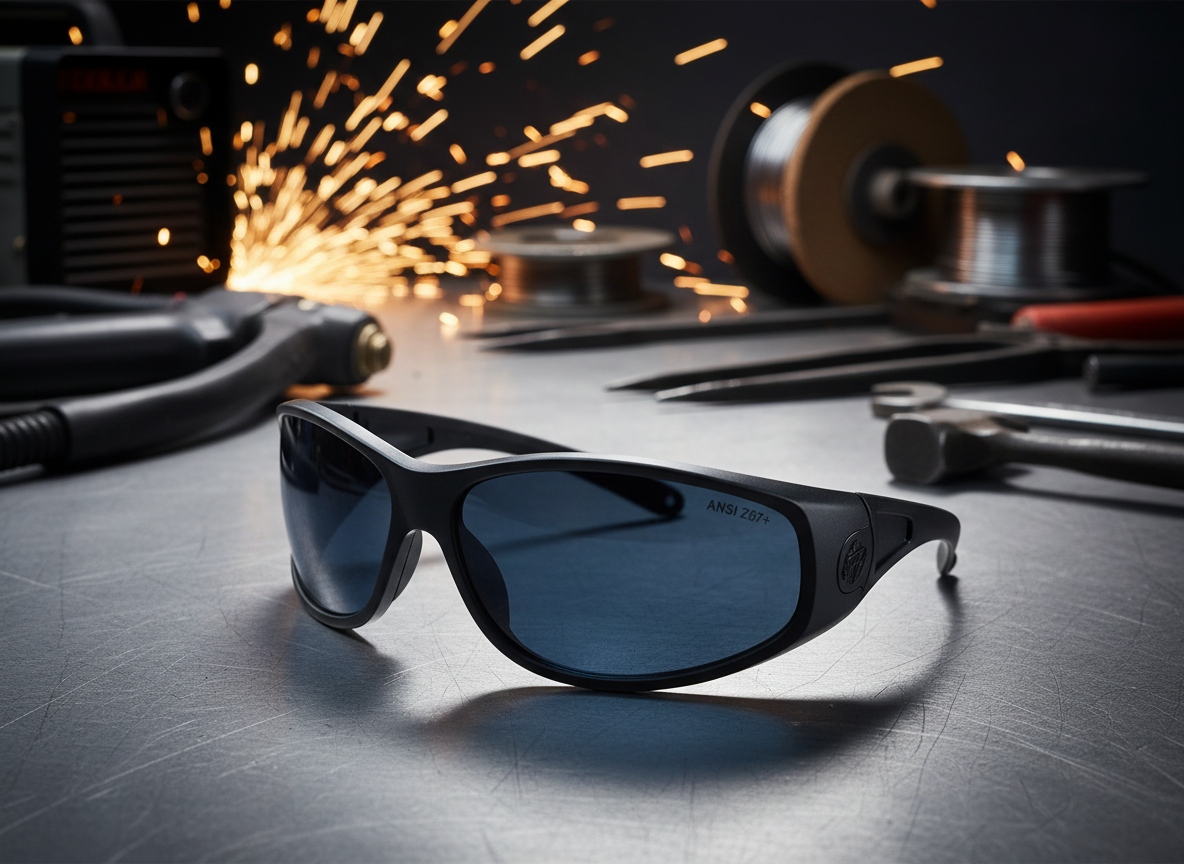
    High Impact (Z87+) – Protects against high-velocity impact (1/4” steel ball at 150 ft/sec) – Required for: Welding, grinding, chipping, cutting – Marking: “Z87+” stamped on frame and lens

    Side Shield Requirement: – All welding safety glasses must have side shields or wraparound design – Prevents spatter and debris from entering around lens edges

    Shade Number Selection by Process

    ProcessAmperage RangeShade NumberLens Type
    Oxy-fuel cuttingN/A#3-#6Fixed shade
    TIG (GTAW)10-50A#8-#10Fixed or auto-darkening
    TIG (GTAW)50-150A#10-#12Fixed or auto-darkening
    MIG (GMAW)60-160A#10-#12Fixed or auto-darkening
    MIG (GMAW)160-250A#12-#14Fixed or auto-darkening
    Stick (SMAW)60-160A#10-#12Fixed shade
    Stick (SMAW)160-250A#12-#14Fixed shade
    Plasma cutting20-40A#4-#5Fixed shade
    Plasma cutting40-80A#5-#8Fixed shade

    Note: Safety glasses are supplemental protection worn under welding helmets or for indirect arc exposure (helper/observer).

    Lens Types & Technologies

    Fixed Shade Lenses

    • Pros: No batteries, consistent darkness, low cost
    • Cons: Single shade only, must swap lenses for different processes
    • Best for: Dedicated single-process work, backup glasses
    • Cost: $10-$30

    Auto-Darkening Lenses

    • Pros: Adjustable shade range, no lens swapping
    • Cons: Battery replacement, higher cost
    • Shade range: Typically #5-#13
    • Reaction time: 0.0001-0.00004 seconds
    • Best for: Multi-process shops, frequent shade changes
    • Cost: $50-$150

    Passive IR/UV Protection (Clear Lenses)

    • Function: Blocks UV and infrared without visible light darkening
    • Use case: Grinding, fabrication, indirect arc exposure (helper/observer)
    • Shade equivalent: #1.5-#2
    • Best for: Non-welding tasks requiring impact protection

    UV & IR Protection Standards

    UV Protection (200-400nm wavelength): – All welding lenses must block 99.9%+ UV radiation – Permanent damage occurs from unprotected UV exposure (arc eye/welder’s flash)

    Infrared Protection (780nm-1mm wavelength): – Blocks heat radiation from welding arc – Prevents retinal damage and cataracts from prolonged exposure

    Visible Light Transmission: – Shade #3: 14.3% transmission (light tint) – Shade #8: 0.58% transmission (moderate darkness) – Shade #12: 0.0018% transmission (very dark)

    Lens Coatings & Features

    Anti-Fog Coating

    • Purpose: Prevents condensation in humid environments or when wearing respirator
    • Best for: Summer welding, enclosed spaces, respirator use
    • Limitation: Coating wears off after 6-12 months

    Anti-Scratch Coating

    • Purpose: Extends lens life in high-abrasion environments
    • Best for: Grinding, fabrication, production shops
    • Hardness rating: 4-6H pencil hardness (military spec MIL-PRF-32432)

    Polarized Lenses

    • Purpose: Reduces glare from reflective surfaces (polished stainless, aluminum)
    • Best for: TIG welding on reflective materials
    • Limitation: Not necessary for carbon steel or general fabrication

    Frame Styles & Fit

    Wraparound Design

    • Coverage: Maximum side and peripheral protection
    • Best for: Grinding, cutting, high-spatter welding
    • Fit: Snug to face, minimal gap around edges

    Over-the-Glass (OTG) Design

    • Purpose: Fits over prescription eyeglasses
    • Best for: Welders who wear corrective lenses
    • Limitation: Bulkier, may not fit all prescription frame sizes

    Prescription Welding Glasses

    • Purpose: Combines corrective lenses with welding shade
    • Best for: Full-time welders who need vision correction
    • Cost: $150-$400 (requires optometrist fitting)

    When to Wear Safety Glasses vs. Helmet

    Safety Glasses (Supplemental Protection)

    • Grinding, cutting, or fabrication (no arc)
    • Indirect arc exposure (helper/observer 10+ feet from arc)
    • Under welding helmet as secondary protection
    • Oxy-fuel cutting or brazing (low UV output)

    Welding Helmet (Primary Protection)

    • Direct arc exposure (TIG, MIG, stick, flux-core)
    • Primary welder performing arc welding
    • Required for all arc welding processes per OSHA 1910.252

    OSHA Requirement: Safety glasses must be worn under welding helmets in environments with grinding, chipping, or multiple welding stations.

    Common Mistakes

    Using non-certified safety glasses for welding
    Fashion sunglasses or non-Z87+ glasses don’t block UV/IR radiation. Result: arc eye (photokeratitis) and permanent retinal damage. Always verify Z87+ marking.

    Wrong shade number for amperage
    Shade #3 glasses for 150A MIG = retinal burn risk. Shade #12 for oxy-fuel cutting = can’t see work. Match shade to process and amperage.

    Skipping safety glasses under helmet
    Grinding debris or spatter can enter under helmet. OSHA requires safety glasses as secondary protection in multi-hazard environments.

    Buying Checklist

    • ✓ ANSI Z87+ certification marked on frame and lens
    • ✓ Shade number matches process and amperage range
    • ✓ UV/IR protection rated for welding (99.9%+ UV block)
    • ✓ Side shields or wraparound design for peripheral protection
    • ✓ Anti-fog coating if working in humid environments
    • ✓ Anti-scratch coating for grinding/fabrication work
    • ✓ Comfortable fit (no pressure points, secure without slipping)
    • ✓ OTG design if wearing prescription glasses

  • Auto-Darkening Welding Helmet Buying Guide 2025 | Lens Speed, Shade Range & Standards

    Auto-Darkening Welding Helmet Buying Guide 2025 | Lens Speed, Shade Range & Standards

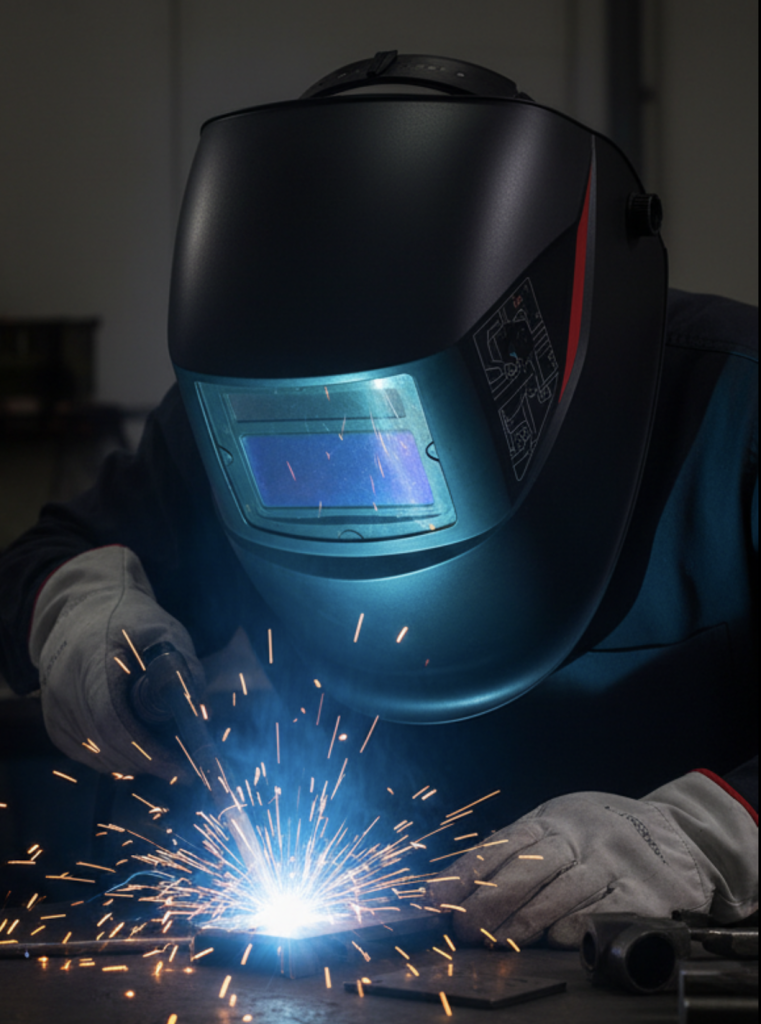
    Auto-darkening helmets protect your eyes by switching from light to dark state when arc strikes. Choosing the right one depends on lens speed, shade range, viewing area, and certification—not brand hype.

    Key Specifications

    Reaction Time (Switching Speed)

    LevelSpeedDecimal
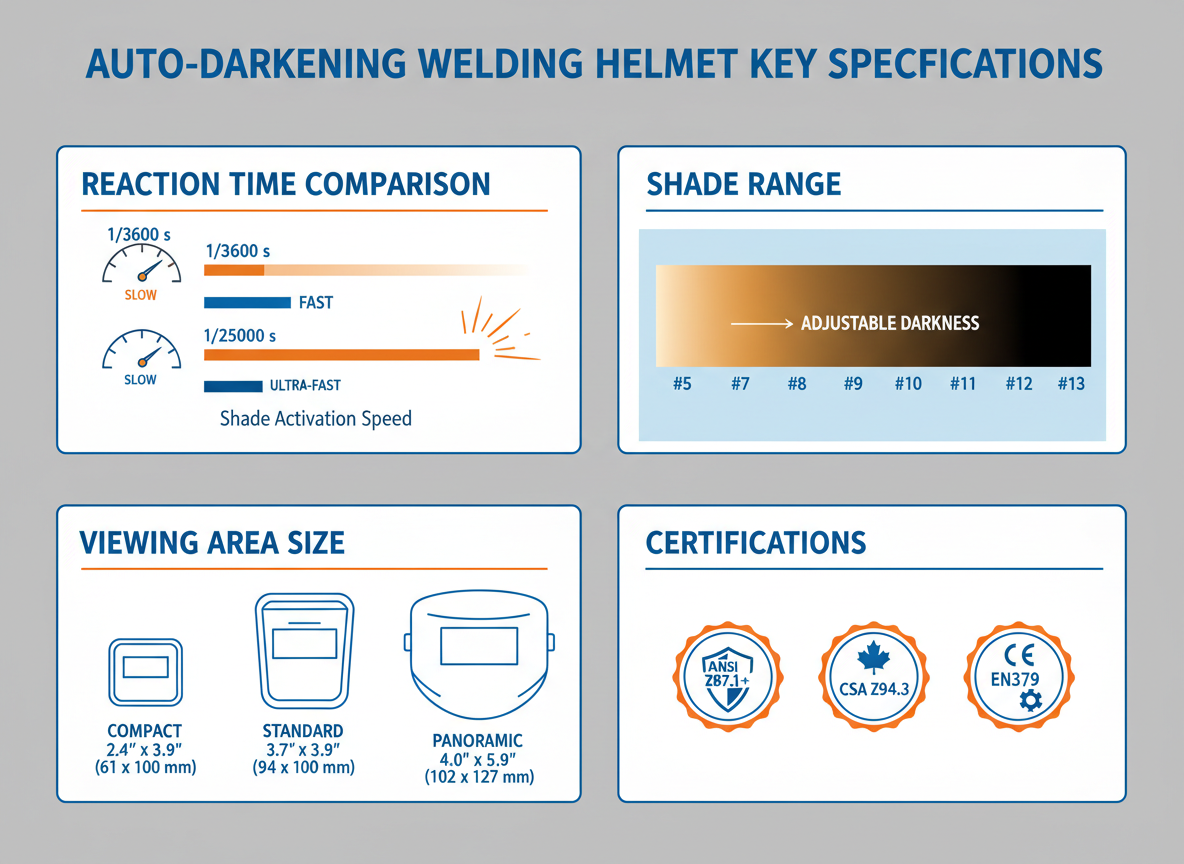
    Entry-level1/3600 second0.00028s
    Mid-range1/10000 second0.0001s
    Professional1/25000 second0.00004s

    TIG welding requires faster response (1/20000s minimum) due to low-amperage arc initiation. MIG and stick work fine with 1/10000s.

    Shade Range

    • Standard range: #9–#13
    • TIG-specific: #5–#13 (low-amp visibility)
    • Grinding mode: #3–#4 (light state)

    AWS D1.1 requires minimum shade #10 for 60–160A stick welding, #11 for 160–250A, #12 for 250–550A.

    Viewing Area

    SizeDimensionsArea
    Compact3.5” × 1.65”6 sq in
    Standard3.93” × 2.36”9.3 sq in
    Wide-view3.93” × 2.87”11.3 sq in
    Panoramic4.25” × 3.25”13.8 sq in

    Larger viewing area improves peripheral awareness in tight spaces and multi-pass work.

    Optical Clarity Rating (1/1/1/1 to 1/1/1/3)

    Four numbers indicate: optical class / light diffusion / variations in luminous transmittance / angle dependence.

    • 1/1/1/1 = highest clarity (minimal distortion)
    • 1/1/1/2 = professional grade
    • 1/1/1/3 = acceptable for general fabrication

    Certification Requirements

    ANSI Z87.1+ (High-Impact Rated)
    Required for all industrial welding environments. Plus symbol (+) indicates high-velocity impact protection.

    CSA Z94.3
    Canadian standard equivalent to ANSI Z87.1+.

    EN379
    European standard covering optical class, switching time, and UV/IR protection.

    Process-Specific Requirements

    TIG (GTAW)

    • Reaction time: 1/20000s or faster
    • Shade range: #5–#13 (low-amp start visibility)
    • Sensitivity adjustment: Essential for low-amperage starts

    MIG (GMAW)

    • Reaction time: 1/10000s acceptable
    • Shade range: #9–#13
    • Spatter resistance: Check lens cover plate availability

    Stick (SMAW)

    • Reaction time: 1/10000s acceptable
    • Shade range: #10–#13
    • Grinding mode: Useful for slag removal between passes

    Flux-Core (FCAW)

    • Same as MIG requirements
    • Higher spatter = more frequent cover plate replacement

    Power Source Options

    Solar-powered

    • Pros: No battery replacement, lighter weight
    • Cons: Requires adequate light exposure, slower recovery in dim environments

    Battery-powered

    • Pros: Consistent performance in all lighting
    • Cons: Battery replacement every 6–12 months (CR2032 or AAA)

    Solar + Battery Hybrid

    • Best reliability for production environments
    • Battery backup prevents downtime

    True Color vs. Standard Lens Technology

    FeatureStandard Green LensTrue Color Lens
    Color perceptionGreen/blue tintNatural color
    Weld pool visibilityAdequateEnhanced
    Heat color distinctionStandardSuperior
    CostBase price2–3× premium
    Best forStructural steelStainless/aluminum TIG

    True color improves precision on stainless and aluminum TIG work but isn’t necessary for structural steel fabrication.

    Buying Checklist

    • ✓ ANSI Z87.1+ certification marked on helmet
    • ✓ Reaction time matches your primary process
    • ✓ Shade range covers your amperage requirements
    • ✓ Viewing area suits your work environment
    • ✓ Optical clarity rating 1/1/1/2 or better
    • ✓ Replacement lens covers readily available
    • ✓ Adjustable sensitivity and delay controls
    • ✓ Grinding mode if you do stick or flux-core

    Common Mistakes

    Buying based on viewing area alone
    Large viewing area with slow reaction time = retina damage risk. Verify switching speed first.

    Ignoring optical clarity rating
    1/1/1/3 lenses cause eye strain during 8+ hour shifts. Pay for 1/1/1/2 if you weld full-time.

    Skipping sensitivity adjustment testing
    Low-amperage TIG (10–40A) won’t trigger poorly calibrated sensors. Test before buying.


  • Welding Fume Exposure in 2025: What’s Changed and What PPE Actually Protects You

    Welding Fume Exposure in 2025: What’s Changed and What PPE Actually Protects You

    Welding fumes have always carried health risks, but 2025 brings a major shift in how OSHA, AWS, and safety professionals are treating long-term exposure. Injury rates in welding have dropped 15% since 2020, but chronic inflammation, respiratory diseases, and cumulative metal-fume toxicity are getting significantly more attention.

    What’s driving the change?
    Stricter exposure limits, new PPE technologies, and better data on how manganese, hexavalent chromium, nickel, and aluminum fumes impact long-term health.

    This guide explains what’s new, what’s trending, and which respirators provide real protection—not just marketing.


    Key Takeaways

    • Chronic inflammation from long-term fume exposure is a major 2025 focus
    • OSHA and ANSI Z49.1 have updated guidance for ventilation and fume extraction
    • PAPRs and tight-fitting respirators are becoming standard, not optional
    • Shops must document airflow, PPE compliance, and exposure reduction
    • Welders need gear that protects against manganese, aluminum oxides, and stainless fumes

    What Changed in 2025

    1. Chronic Inflammation Identified as a High-Priority Health Risk

    Research now links long-term fume exposure to:

    • Chronic lung inflammation
    • Reduced lung function
    • Cardiovascular stress
    • Increased sensitivity to airborne metals

    OSHA has signaled more aggressive enforcement on fume control, especially in enclosed fabrication environments.


    2. Stronger Requirements for Fume Extraction & Ventilation

    ANSI Z49.1 (Safety in Welding, Cutting, and Allied Processes) now emphasizes:

    • Mandatory local exhaust ventilation in most shop environments
    • Airflow documentation for enclosed welding stations
    • Regular fume monitoring for stainless, galvanized, and hardfacing work

    Shops that relied on “general ventilation” are being pushed toward mechanical extraction.


    3. PPE Expectations Increased Across Industries

    Old disposable masks don’t cut it anymore. For metal fume exposure, the standard is shifting toward:

    • Elastomeric half-mask respirators with P100 filters
    • PAPRs for long-duration welding or stainless applications
    • Integrated hood systems for high-particulate shops

    Shops are required to treat fume protection as “essential PPE,” not optional.


    Where Welders Are Most at Risk

    The highest fume loads appear in:

    • MIG welding in confined areas

    High particulate, high manganese content.

    • Stainless steel welding (GMAW, GTAW, FCAW)

    Hexavalent chromium risk.

    • Hardfacing and high-heat processes

    High metal concentration and oxide generation.

    • Multi-pass structural welding

    Sustained exposure on thick materials increases cumulative load.


    Recommended PPE for Real Protection (Not Marketing Claims)

    Below are two Miller respirators your audience already trusts and you want to sell. These are ideal for 2025’s stricter fume-control expectations.


    Miller LPR-100 (295273 / 295274)

    A low-profile, P100-rated respirator designed specifically for welding hoods.

    Why it stands out:

      • Tight-seal fit designed for welding helmets
      • Filters block 99.97% of airborne particulates
      • Compact design prevents interference with PAPR hoses or helmets
      • Great for MIG, Stick, and TIG operations
      • Lower breathing resistance than many elastomeric masks

    Where to Buy

    ArcWeld Store:
    Miller 295273 LPR-100 Gen. II Half Mask Respirator with Nuisance OV Relief, S/M Size

    “>
    Miller 295273 LPR-100 Gen. II Half Mask Respirator with Nuisance OV Relief, S/M Size

    Miller 295273 LPR-100 Gen. II Half Mask Respirator with Nuisance OV Relief, S/M Size

    $59.72

    In Stock

    View Product

    Miller LPR-100 Gen. II Half Mask Respirator with P-100 Nuisance Organic Vapor Relief, M/L

    “>
    Miller LPR-100 Gen. II Half Mask Respirator with P-100 Nuisance Organic Vapor Relief, M/L

    Miller LPR-100 Gen. II Half Mask Respirator with P-100 Nuisance Organic Vapor Relief, M/L

    $59.72

    In Stock

    View Product

    Amazon:

    Miller LPR-100 Gen. II Half Mask Respirator, Nuisance OV Relief M/L – Welding Respirator Mask with Filters – P100 Respirator Mask for Filtrating Particulates & Aerosols – Respirator Under Helmet
    • Enhanced Protection with Nuisance OV Relief Filters: The Miller LPR-100 Gen. II Half Mask Respirator, Nuisance OV Relief M/L includes an added carbon layer feature to reduce nuisance-level organic vapor odors; Our respirator mask with filters helps ensure clean, breathable air for welders working in fume-intensive environments
    • Up to 99.97% Filtration: Upgrade your welding gear with our respirator mask; Strongly resistant to oil, the filters of our respirators help provide reliable filtration of airborne particles, including solid dust, metal fumes and mists
    • Compact Low-Profile Design for Welding Helmets: The slim design of our welding respirator under helmet offers a wide field of vision and fits easily under most welding helmets; Our respirator is designed to help provide full compatibility with your protective eyewear and headgear
    • Ergonomic Half-Mask Respirator for Extended Comfort: Crafted for long welding shifts, our half face respirator features minimal dead air space to reduce heat buildup; It also comes with a large non-return exhaust valve to help minimize user fatigue during high-demand tasks
    • Durable, Medical-Grade Materials: Made with latex- and silicone-free materials, this half mask face respirator is odor-free, hypoallergenic; It is also built to withstand demanding welding environments while providing user comfort and safety

    Last update on 2025-12-05 / Affiliate links / Images from Amazon Product Advertising API

    Miller LPR-100 Gen. II Half Mask Respirator, Nuisance OV Relief S/M – Welding Respirator Mask with Filters – P100 Respirator Mask for Filtrating Particulates & Aerosols – Respirator Under Helmet
    • Enhanced Protection with Nuisance OV Relief Filters: The Miller LPR-100 Gen. II Half Mask Respirator, Nuisance OV Relief S/M includes an added carbon layer feature to reduce nuisance-level organic vapor odors; Our respirator mask with filters helps ensure clean, breathable air for welders working in fume-intensive environments
    • Up to 99.97% Filtration: Upgrade your welding gear with our respirator mask; Strongly resistant to oil, the filters of our respirators help provide reliable filtration of airborne particles, including solid dust, metal fumes and mists
    • Compact Low-Profile Design for Welding Helmets: The slim design of our welding respirator under helmet offers a wide field of vision and fits easily under most welding helmets; Our respirator is designed to help provide full compatibility with your protective eyewear and headgear
    • Ergonomic Half-Mask Respirator for Extended Comfort: Crafted for long welding shifts, our half face respirator features minimal dead air space to reduce heat buildup; It also comes with a large non-return exhaust valve to help minimize user fatigue during high-demand tasks
    • Durable, Medical-Grade Materials: Made with latex- and silicone-free materials, this half mask face respirator is odor-free, hypoallergenic; It is also built to withstand demanding welding environments while providing user comfort and safety

    Last update on 2025-12-05 / Affiliate links / Images from Amazon Product Advertising API

    Disclosure: This article contains affiliate links. As an Amazon Associate, I earn from qualifying purchases.


    Ventilation: What Actually Works in 2025

    1. Local Exhaust Extraction (LEV)

    Most effective. Pulls fumes at the arc before they reach the welder.

    2. High-Volume Portable Fume Extractors

    Good for small fabrication shops; less ideal for high-production cells.

    3. PAPR Systems

    Best for stainless or long-duration welding. (Optrel Helix Pure Air, 3M Adflo, Miller PAPR)

    4. Clean-Air Booths

    High-end solution for training centers and production facilities.


    Why Shops Should Care

    1. Non-compliance = OSHA fines

    OSHA’s 2025 inspection priority includes fume exposure logs and ventilation plans.

    2. Better PPE lowers long-term medical claims

    Reduced inflammation = fewer chronic issues = lower insurance cost.

    3. Certified welders are billing higher rates

    Because the PPE requirements are stricter and more expensive.


    Safety Notes (AWS/ANSI References)

    • Follow ANSI Z49.1 for ventilation and exposure limits
    • Use NIOSH-approved P100 filters
    • Respirator fit testing required under OSHA 1910.134
    • For stainless and galvanized steel, ensure proper local extraction
    • Replace filters per manufacturer schedule or earlier if breathing resistance increases

    FAQ

    Do welders need a respirator in 2025?
    For most shop work—yes. Exposure standards are stricter, and many shops mandate P100 or PAPR.

    Is a disposable mask enough?
    Not for welding. Disposable masks do not meet P100 fume protection standards.

    Which is better, a PAPR or a tight-fitting respirator?
    PAPR = best for long-duration or stainless welding.
    P100 = excellent for general welding and a huge improvement over older PPE.

    Does fume extraction replace respirators?
    No. They work together. Extraction reduces airborne load; respirators protect your lungs directly.

  • Black Stallion GX5015 TIG/Mechanics Gloves Review & Buying Guide (L & XL)

    Black Stallion GX5015 TIG/Mechanics Gloves Review & Buying Guide (L & XL)

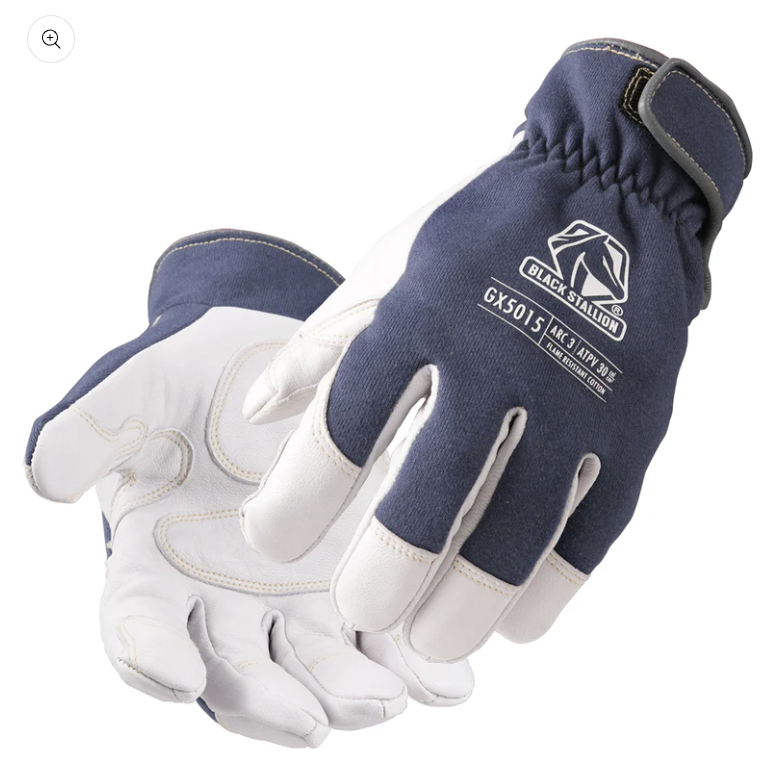
    The Black Stallion GX5015 series blends TIG-glove dexterity with mechanics-glove structure — now with a verified ARC 3 rating and an ATPV of 30 cal/cm², making these one of the safest crossover TIG/mechanics gloves in their class.

    If you weld stainless, carbon steel, or aluminum and need a glove that handles fit-up, layout, and light fabrication while still meeting arc-flash PPE requirements, the GX5015 checks the boxes.

    Below is the full review of the Large (GX5015-L) and X-Large (GX5015-XL) models.


    Key Takeaways

    • ARC Rating: 3 — suitable for tasks requiring arc-flash category 3 PPE.
    • ATPV 30 cal/cm² — strong thermal protection for incidental electrical arc exposure.
    • Goatskin palm delivers excellent feel for TIG tacks, fit-up, and fine-control tasks.
    • FR cotton back increases heat resistance vs. synthetic mechanics gloves.
    • True-to-size fit available in Large and X-Large.

    What These Gloves Solve

    Regular mechanics gloves can melt or shrink under heat. Basic TIG gloves feel great but lack structure and impact support.

    The GX5015 bridges that gap:

    • Better structure and durability than TIG gloves.
    • Better heat performance vs. standard mechanics gloves.
    • ARC 3 / ATPV-30 protection for shops that require electrical arc compliance.

    These are a strong choice for TIG-first welders who also handle tools, grinders, fabrication, and general shop work.


    Features & Materials

    Palm: Premium goatskin — smooth, tactile, reinforced.
    Back: FR cotton with ARC 3 rating and ATPV 30 cal/cm² performance.
    Cuff: Slip-on, quick-access style.
    Fit: Snug TIG-style feel with stable mechanics-glove support.
    Stitching: Kevlar® thread.
    Use Cases: TIG welding, stainless/aluminum, layout, bench work, fit-up, tool handling, shop maintenance.


    Size Options Reviewed

    GX5015-L — Large

    ArcWeld Store:
    Black Stallion GX5015L, Large ARC-Rated Goatskin & FR Cotton Tig & Mechanics Glove (1 Pair)

    “>
    Black Stallion GX5015L, Large ARC-Rated Goatskin & FR Cotton Tig & Mechanics Glove (1 Pair)

    Black Stallion GX5015L, Large ARC-Rated Goatskin & FR Cotton Tig & Mechanics Glove (1 Pair)

    $32.41

    In Stock

    View Product

    Amazon (ASIN: B079J6JV95):

    Sale
    GX5015L ARC-Rated Goatskin & FR Cotton Tig & Mechanics Glove (1 Pair) Large Size
    • Premium grain goatskin palm & fingertips
    • Flame-resistant cotton back and fleece lining
    • Goatskin reinforcements on palm & fingertips
    • Seamless index finger eliminates seam rub
    • Available in Sizes: S-2XL

    Last update on 2025-12-05 / Affiliate links / Images from Amazon Product Advertising API


    GX5015-XL — X-Large

    ArcWeld Store:
    Black Stallion GX5015XL, X-Large ARC-Rated Goatskin & FR Cotton Tig & Mechanics Glove (1 Pair)

    “>
    Black Stallion GX5015XL, X-Large ARC-Rated Goatskin & FR Cotton Tig & Mechanics Glove (1 Pair)

    Black Stallion GX5015XL, X-Large ARC-Rated Goatskin & FR Cotton Tig & Mechanics Glove (1 Pair)

    $29.89

    In Stock

    View Product

    Amazon (ASIN: B079YYG1WX):

    Black Stallion Revco Industries GX5015-NW- XL ARC-Rated Goatskin & FR Cotton Mechanics Glove Size XLarge
    • Premium grain goatskin palm & fingertips
    • Flame-resistant cotton back and fleece lining
    • Goatskin reinforcements on palm & fingertips
    • Seamless index finger eliminates seam rub
    • Available in Sizes: S-2XL

    Last update on 2025-12-05 / Affiliate links / Images from Amazon Product Advertising API


    Comparison Table

    ModelKey SpecsBest For
    GX5015-L (Large)ARC 3, ATPV 30, goatskin palm, FR cotton back, Kevlar stitchingTIG, light fab, electrical-arc compliant shops
    GX5015-XL (X-Large)ARC 3, ATPV 30, same constructionBigger hands, daily TIG work, shop tasks

    Safety Notes


    FAQ

    Are these safe for electrical-arc hazards?
    Yes — ARC 3 with ATPV 30 cal/cm². Always confirm with your facility’s PPE matrix.

    Good for high-heat TIG?
    Suitable for light-to-moderate TIG heat. For continuous high-amp (>150–200 A), choose full leather TIG gloves.

    Do they last?
    Goatskin holds up better than many synthetic mechanics gloves. Heavy grinding will shorten life but general fab use is fine.

    Do they fit true?
    Yes — Large fits most welders; XL is for bigger hands without being loose.


    Sources Checked


  • Black Stallion Flame-Resistant Welding Jacket Review (2025)

    Black Stallion Flame-Resistant Welding Jacket Review (2025)

    Durable FR cotton, solid coverage, and reliable protection without the heat load of leather — the Black Stallion F9-30C is one of the best-value welding jackets for everyday shop work. This guide breaks down material performance, fit, use cases, and whether it’s worth adding to your PPE lineup.


    Key Takeaways

    • 9 oz FR cotton offers lightweight, breathable protection for MIG, TIG, and light stick.
    • ASTM D6413-tested flame resistance (self-extinguishing).
    • Stand-up welder’s collar + inside/outside pockets.
    • Ideal for fabrication, repair shops, and long sessions where leather is too hot.
    • Budget-friendly PPE upgrade with trusted Black Stallion build quality.

    Where to Buy

    Arc Weld Store:
    Flame-Resistant Welding Jacket – Black Stallion

    , Flame Resistant Welding Jacket, Black Stallion JF1625-NG, Navy/Gray, Lightweight Large Size
    “>
    Flame Resistant Welding Jacket, Black Stallion JF1625-NG, Navy/Gray, Lightweight Large Size

    Flame Resistant Welding Jacket, Black Stallion JF1625-NG, Navy/Gray, Lightweight Large Size

    $39.37

    In Stock

    View Product
    , Black Stallion JF1625-NG Flame Resistant Welding Jacket, Navy/Gray, X-Large, Breathable Comfort
    “>
    Black Stallion JF1625-NG Flame Resistant Welding Jacket, Navy/Gray, X-Large, Breathable Comfort

    Black Stallion JF1625-NG Flame Resistant Welding Jacket, Navy/Gray, X-Large, Breathable Comfort

    $39.61

    Sold Out

    View Product
    , Black Stallion JF1625-NG Stretch-Back FR Cotton Welding Jacket, Navy/Gray, 2X-Large

    Black Stallion JF1625-NG Stretch-Back FR Cotton Welding Jacket, Navy/Gray, 2X-Large

    $40.77

    In Stock

    View Product
    “>
    Black Stallion JF1625-NG Stretch-Back FR Cotton Welding Jacket, Navy/Gray, 2X-Large

    Black Stallion JF1625-NG Stretch-Back FR Cotton Welding Jacket, Navy/Gray, 2X-Large

    $40.77

    In Stock

    View Product

    Amazon:

    Black Stallion JF1625-NG Stretch-Back FR Cotton Welding Jacket, Navy/Gray, Medium
    • 9 oz. FR cotton front, sleeves, & collar (Navy) and 7 oz. FR cotton stretch knit back (Heather Gray)
    • Stand-up welder’s collar for enhanced protection
    • 6 powder-coated stainless steel front snaps & wrist snaps and Leather reinforcements on all front snaps
    • Scribe pocket holds welding pencils, soapstone, & paint markers and Inside pocket keeps small items secure
    • 32″ Length and Available in Sizes: Small, Medium, Large, X-Large, 2X-Large, 3X-Large, 4X-Large, and 5X-Large
    Black Stallion JF1625-NG Stretch-Back FR Cotton Welding Jacket, Navy/Gray, Large
    • 9 oz. FR cotton front, sleeves, & collar (Navy) and 7 oz. FR cotton stretch knit back (Heather Gray)
    • Stand-up welder’s collar for enhanced protection
    • 6 powder-coated stainless steel front snaps & wrist snaps and Leather reinforcements on all front snaps
    • Scribe pocket holds welding pencils, soapstone, & paint markers and Inside pocket keeps small items secure
    • 32″ Length and Available in Sizes: Small, Medium, Large, X-Large, 2X-Large, 3X-Large, 4X-Large, and 5X-Large
    Black Stallion JF1625-NG Stretch-Back FR Cotton Welding Jacket, Navy/Gray, X-Large
    • 9 oz. FR cotton front, sleeves, & collar (Navy) and 7 oz. FR cotton stretch knit back (Heather Gray)
    • Stand-up welder’s collar for enhanced protection
    • 6 powder-coated stainless steel front snaps & wrist snaps and Leather reinforcements on all front snaps
    • Scribe pocket holds welding pencils, soapstone, & paint markers and Inside pocket keeps small items secure
    • 32″ Length and Available in Sizes: Small, Medium, Large, X-Large, 2X-Large, 3X-Large, 4X-Large, and 5X-Large
    Black Stallion JF1625-NG Stretch-Back FR Cotton Welding Jacket, Navy/Gray, 2X-Large
    • 9 oz. FR cotton front, sleeves, & collar (Navy) and 7 oz. FR cotton stretch knit back (Heather Gray)
    • Stand-up welder’s collar for enhanced protection
    • 6 powder-coated stainless steel front snaps & wrist snaps and Leather reinforcements on all front snaps
    • Scribe pocket holds welding pencils, soapstone, & paint markers and Inside pocket keeps small items secure
    • 32″ Length and Available in Sizes: Small, Medium, Large, X-Large, 2X-Large, 3X-Large, 4X-Large, and 5X-Large

    Last update on 2025-12-05 / Affiliate links / Images from Amazon Product Advertising API


    Affiliate Disclosure: As an Amazon Associate, we earn from qualifying purchases.


    Black Stallion FR Welding Jacket: Overview

    Black Stallion’s F9-30C/BN line is designed for welders who need protection without the weight of full-leather. The jacket is a shop staple for MIG, TIG, and light stick — especially in warm environments where breathability matters.


    Material & Build Quality

    Why it works: FR cotton chars rather than melting, giving solid protection for sparks, grinding debris, and low-to-medium heat welding processes.


    Fit & Comfort


    Protection Level

    Best for:

    Not recommended for:


    Who Should Buy It

    This jacket hits the sweet spot for:


    Safety Notes


    FAQ

    Is FR cotton good enough for welding?

    Yes — for MIG, TIG, and general shop use. It’s not suitable for heavy stick or high-slag jobs where leather is required.

    Does the jacket shrink?

    FR cotton can shrink slightly after the first wash. Order true-to-size; most welders do not need to size up.

    How long does the FR treatment last?

    FR performance is built into the fabric and stays effective when washed correctly (no bleach or softeners).

    Is this good for hot-weather welding?

    Yes — that’s one of its biggest advantages versus leather.

  • Watch with Prime Video