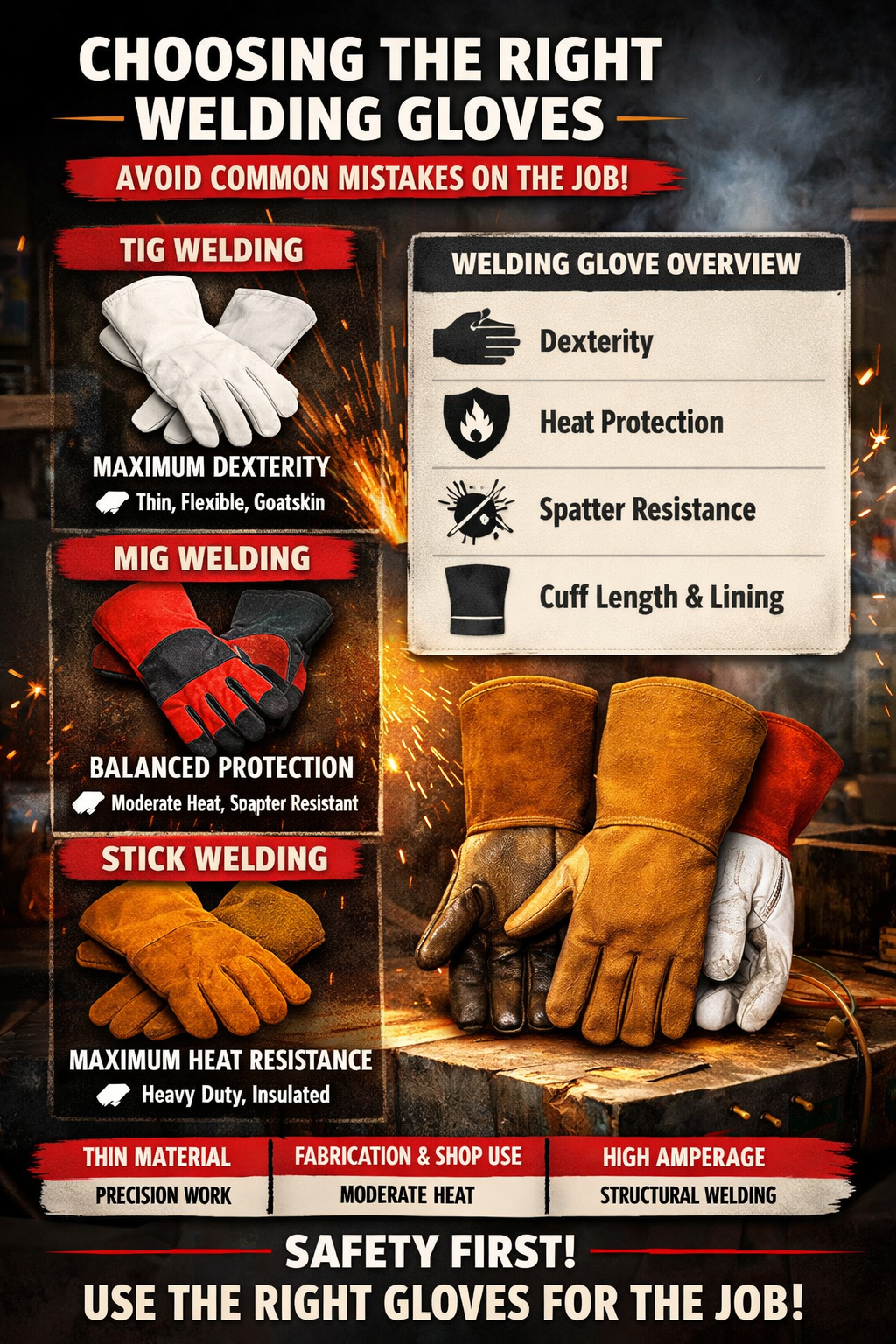
Welding gloves look similar on the rack, but the wrong type will cost you control, comfort, or protection on the job. MIG, TIG, and Stick welding all place different demands on gloves. This guide breaks down the real differences so you can choose correctly and avoid common mistakes.
Key Takeaways
- TIG gloves prioritize dexterity over heat resistance
- MIG gloves balance protection and flexibility
- Stick welding requires maximum heat and spatter protection
- Leather type, cuff length, and lining matter more than brand name
Why Welding Gloves Are Process-Specific
Each welding process produces different heat levels, arc duration, and spatter. Gloves are designed to manage these variables through leather thickness, stitching type, and insulation. Using the wrong glove usually results in poor control or premature glove failure.
TIG Welding Gloves: Maximum Dexterity
TIG welding requires fine torch and filler control. Gloves are typically thin, unlined, and made from goatskin or deerskin. Heat protection is limited and not suitable for heavy amperage or prolonged arc time.
Best use cases:
- Precision TIG work
- Thin material
- Bench or shop welding
MIG Welding Gloves: Balanced Protection
MIG gloves are thicker than TIG gloves and often lightly lined. They provide better spatter resistance while maintaining enough dexterity for gun control and part handling.
Best use cases:
- Fabrication and production MIG welding
- Moderate amperage work
- General shop use
Stick Welding Gloves: Maximum Heat Resistance
Stick welding produces the most heat and spatter. Gloves are heavily insulated with thicker cowhide or elk leather and extended cuffs. Dexterity is reduced, but protection is the priority.
Best use cases:
- High-amperage Stick welding
- Structural and field work
- Overhead or vertical welding
Comparison Table
| Model | Key Specs | Best For |
|---|---|---|
| Tillman 750 | Goatskin, unlined, short cuff | TIG welding |
| Miller MIG Gloves | Cowhide, light lining | MIG fabrication |
| Lincoln Stick Gloves | Heavy cowhide, insulated | Stick welding |
Safety Notes (ANSI / AWS)
- Welding gloves should meet ANSI Z49.1 requirements for protective equipment
- Never substitute TIG gloves for high-heat Stick welding
- Replace gloves immediately if holes or seam failures appear
FAQ
Can I use TIG gloves for MIG welding?
Only for light MIG work. Spatter will quickly damage thin TIG gloves.
Why do Stick gloves feel bulky?
Extra insulation and thicker leather are required to handle higher heat and slag.
What leather is best for welding gloves?
Goatskin for dexterity, cowhide for durability, elk for maximum heat resistance.
Do welding gloves expire?
No, but leather degrades with heat, UV exposure, and moisture.
Sources to Verify
- Leather thickness and lining specifications per glove model
- ANSI Z49.1 current revision
- Manufacturer temperature resistance claims

Leave a Reply