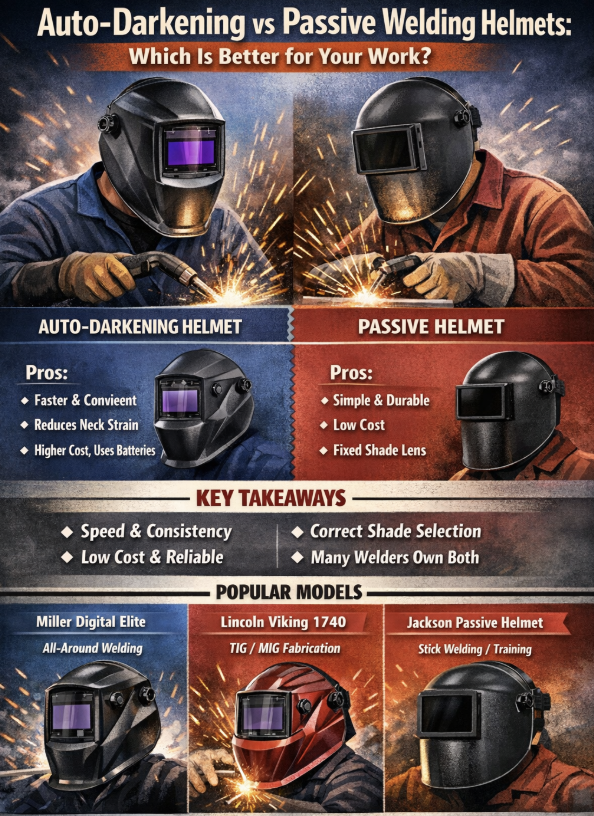
Choosing the right welding helmet affects safety, productivity, and fatigue. Auto-darkening and passive helmets both protect your eyes, but they perform very differently in daily welding. This guide breaks down the real pros and cons so you can choose what fits your work.
Key Takeaways
- Auto-darkening helmets improve speed and consistency, especially for tack-heavy work
- Passive helmets are simple, durable, and low-cost with zero electronics
- Correct shade selection matters more than helmet price
- Many welders keep both styles in the shop
Auto-Darkening vs Passive Helmets
Auto-darkening helmets switch from light to dark when the arc starts, allowing clear visibility during fit-up and positioning. Passive helmets use a fixed-shade lens and must be lowered before striking an arc.
Pros and Cons of Auto-Darkening Helmets
Auto-darkening helmets reduce neck strain, speed up workflow, and make tacking easier. Downsides include higher upfront cost and reliance on batteries or electronics.
Pros and Cons of Passive Helmets
Passive helmets are extremely reliable and inexpensive, but slow down work and increase the chance of missed starts or poor positioning.
Which Helmet Is Right for You
Production welding, fabrication, and TIG work benefit most from auto-darkening helmets. Stick welding outdoors, training environments, and backup use often favor passive helmets.
Comparison Table
| Model | Key Specs | Best For |
|---|---|---|
| Miller Digital Elite | Auto-darkening, grind mode, ANSI Z87.1 | All-around shop welding |
| Lincoln Viking 1740 | Auto-darkening, wide view | TIG/MIG fabrication |
| Jackson Passive Helmet | Fixed shade, lightweight | Stick welding, training |
Safety Notes (ANSI / AWS)
- Helmets must meet ANSI Z87.1 impact and optical requirements
- Always select proper shade levels based on welding process and amperage
- Test auto-darkening function before each use
FAQ
Is auto-darkening safer than passive?
Both are safe when compliant and used correctly.
Do passive helmets damage your eyes?
No, as long as the correct shade is used.
What shade should I use?
Most MIG and Stick welding uses shade 10–11; TIG varies by amperage.
Sources to Verify
- Viewing area and optical ratings per helmet model
- Battery type and service life for auto-darkening lenses

Leave a Reply